Reflecting on History While Planning for Our Future
Over this past year, as part our organization’s work to plan for the coming years and develop a comprehensive strategic plan, I’ve had the opportunity to speak with a wide range of stakeholders — members, volunteers, coalition partners, long-time activists, and new allies.
As someone who has spent more than a decade working at American Atheists, those conversations were illuminating. They, and indeed the entire strategic planning process, allowed me to take a step back from the urgency of the moment and reflect on the bigger picture.
It’s crystal clear that our community is at a crossroads. American society is undergoing a massive cultural shift and religion has lost much of its power. People distrust religious figureheads, question religious orthodoxy, and abandon religious institutions.
For the majority of Americans, the choice to leave the religion they were raised in, to check “none of the above” when asked which religion they identify with, is no longer the sort of thing that upends their lives and destroys relationships.
But that experience is not universal. As our own research has shown, millions of Americans — particularly those who live in rural parts of the country or who were raised in high-control religious communities — still face levels of stigma and discrimination that dramatically worsen their daily lives. Despite survey after survey showing that almost 30% of Americans are nonreligious and between 10 and 15% lack belief in a god, just 5% call themselves atheists.
And when it comes to our government, Christian Nationalism is ascendant at all levels. The federal judiciary, stacked with religious extremists, undercuts secularism whenever it’s presented with the opportunity. Christian Nationalist politicians have seemingly abandoned any attempt at winning elections fair and square, preferring instead to rig the system to seize and hold power.
At a time when atheists and other nonreligious Americans represent the largest single “religious” demographic in the United States, we’re still largely shut out of the halls of political power and too often used as political punching bags.
What we do to confront this reality is the question we’re presented with. How do we, an organization with 60 years of history behind us, learn from our experiences, communicate our values, and rise to the moment will define what role we have in shaping the future — whether it’s the sort of future we would want to live in and would be proud to leave behind for our descendants, or the sort of future that reflects the dark, exclusionary, and bigoted values of our opponents.
At our upcoming national conference in Philadelphia, we will be discussing our organization’s vision for the future and our plans for getting there.
I’m proud of the work that we’ve done over the course of our 60 years, but I’m acutely aware of where we’ve faltered and where we could have — and indeed should have — done better.
In this issue, you’ll find a special section that explores the founding of American Atheists and some lessons we can take from those early days. We’ve also included extended interviews with people who have spent decades of their lives working with American Atheists and with our broader community.
In the coming months, you’ll hear more about our ambitious plans for 2024 and beyond. To borrow a phrase Carl Sagan once wrote about astronomy, reflecting on our history is “a humbling and, I might add, character-building experience.” So for now, I hope we can use this anniversary to embrace our humility and build on our experiences.
Rising to Today’s Challenges
Speaking with people in our community, especially younger atheists, it often occurs to me that a world without American Atheists and organizations like ours is hard to imagine. To them, the 60-year history of this organization seems like an eternity. The growth of atheism, and of atheists, in America and our rising influence? An inevitability.
The progress that has been made over the course of this organization’s history makes the ascendancy of White Christian Nationalism in America today all the more alarming. The air of inevitability some have felt as we notched victories to the fight to protect church-state separation, bolstered in no small part by a steady march of demographics that finds nearly a third of Americans are now nonreligious, is gone. In its place, we find a stark reality that is reminiscent of the days before American Atheists existed.
We shouldn’t be suprised by the ebb and flow of progress. After all, the entire history of this organization and the modern atheist movement in the United States is less than a single lifetime old.
Some of us remember firsthand a time when mandatory prayers and compulsory Bible readings by students were commonplace in public schools. Atheists were distrusted by our coworkers, stigmatized by communities, ignored and mischaracterized by the press, and faced overt discrimination at the hands of government officials. Atheists and other nonreligious people had no community spaces to find common cause and come together.
Some of us not only remember those days; we still experience it today.
While it would border on delusion to pretend that all of these problems have been solved in the past 60 years, it’s unquestionable that this organization, its founders, its leaders, staff and volunteers, and its members have moved the needle toward equality and justice in that time.
So as we embark on the next 60 years of our work, we’re presented with an opportunity to reflect upon our history, learn from the mistakes we’ve made, and move forward together as we prepare for the next fight.
The First Fight: Challenging State-Sanctioned Prayer in Public Schools
The earliest traces of American Atheists date to 1960. In Baltimore, Maryland, Madalyn Murray was disturbed by the daily practice of Bible reading and recitation of the Lord’s Prayer in her son William’s public school. William, then 14, refused to participate and was subjected to bullying by his classmates—ignored and even condoned by administrators.
Madalyn filed a lawsuit against the Baltimore Public School System, alleging that these religious activities in public schools violated the First Amendment rights of students by requiring participation in religious practices.
Despite losing in state court, the case, initially filed as Murray v. Curlett, was consolidated with another similar case, Abington School District v. Schempp, when it was appealed to the U.S. Supreme Court.
On June 17, 1963, the Supreme Court delivered its landmark decision in the case, ruling that mandatory Bible reading in public schools was unconstitutional. The Court, in an 8-1 decision, underscored the importance of maintaining a strict separation between church and state, especially within public educational institutions. Justice Tom C. Clark, writing for the majority, emphasized that the First Amendment was designed to prevent government intrusion into religious matters and to ensure that public institutions, including schools, remained neutral in matters of religion, “while protecting all, prefer[ring] none, and disparag[ing] none.”
These lawsuits should not be seen in isolation; they were indeed part of a broader movement challenging the place of religion in public institutions during a period of significant social and cultural upheaval in the United States.
Put another way, Madalyn’s lawsuit against the Baltimore schools was more than just a legal battle. It was a defining moment in the ongoing debate over the role of religion in public life in America. The Supreme Court’s decision in her case was the second significant victory for advocates of secularism and church-state separation—following the Court’s decision in Engel v. Vitale, ruling that the sanctioning of prayers by public schools was a violation of the Establishment Clause—and reaffirmed the principle that public schools should be spaces free from religious indoctrination.
The fallout from the decision was immediate and widespread, with Madalyn becoming both a hero to some and a villain to others.
She and her family received near constant threats. In an interview with Playboy magazine in 1965, Madalyn said, “[M]y life and the life of my family has been completely disrupted in absolutely every way. But it’s been worth it. It’s uncovered a vast cesspool of illegitimate economic and political power in which the Church is immersed right up to its ears, and I intend to dive in headfirst and pull it out of there dripping wet for all the world to see -- no matter how long it takes, no matter whose feet get stepped on in the process, no matter how much it costs, no matter how great the personal sacrifice.”
She continued her activism, but was forced to flee Baltimore. In addition to the threats, her home was vandalized and her son Garth’s pet kitten was killed. After arriving in Austin, Texas, Madalyn founded and become the first president of the Society of Separationists, the precursor to American Atheists.
To say that Madalyn’s lawsuit against the Baltimore schools was a watershed moment in American legal and cultural history would be an understatement. Not only did her actions help change the practice of mandatory school prayer and upend Christian privilege in public schools, her outspokenness started—and continued—a national conversation about the boundaries between religion and government, the role of religion in public life, and the place of religion in individuals’ lives.
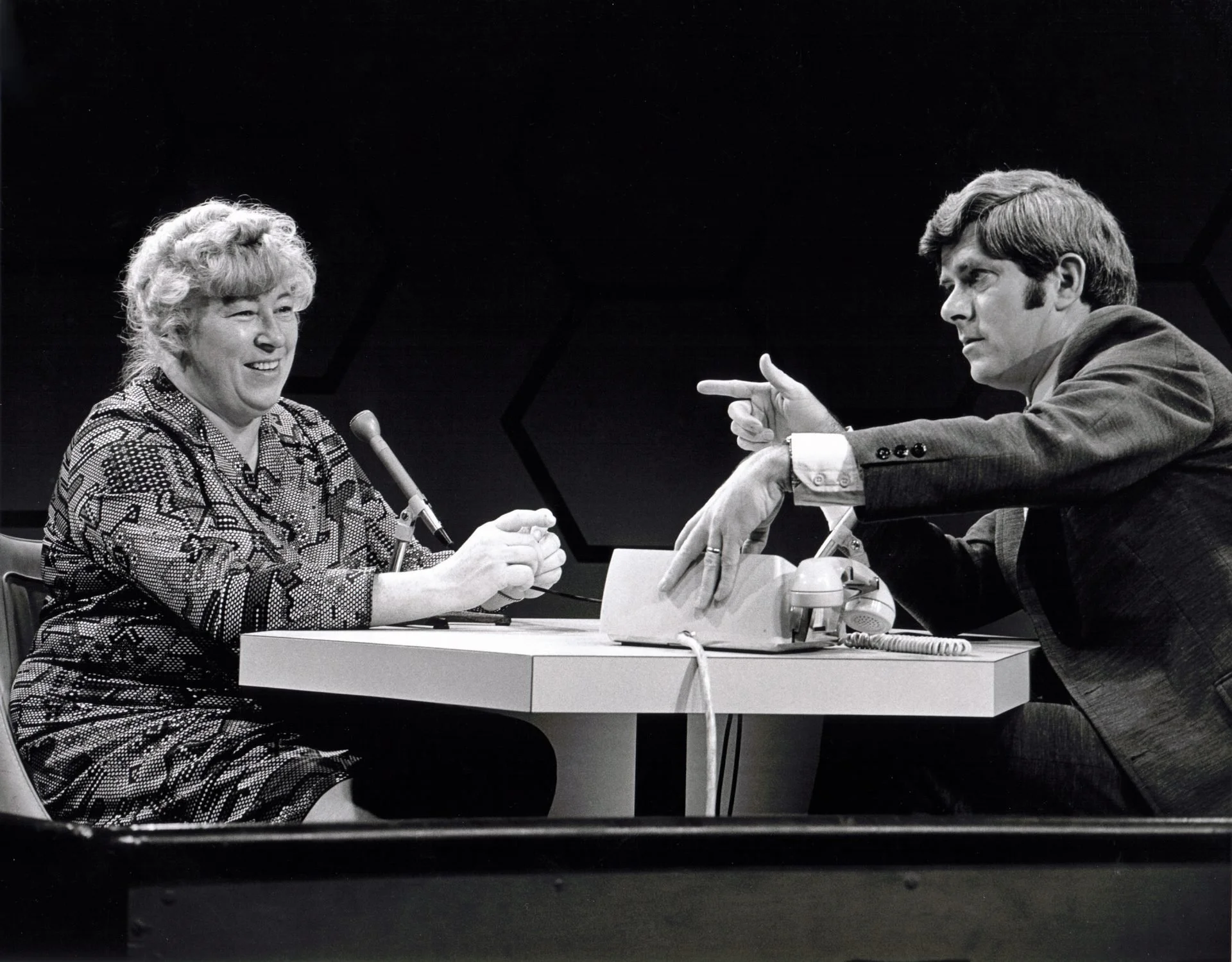
Madalyn’s willingness to sharply criticize religion’s privileged place in American society and large public profile as an outspoken atheist made her a frequent guest on talk shows and popular media. For many, Madalyn’s appearances on The Phil Donahue Show, The Tonight Show with Johnny Carson, or on a debate stage were the first times they encountered an atheist.
For the Religious Right, Madalyn was a convenient foil and bogeywoman—someone they could point to to frighten their base and gin up support and money.
Lessons to be Learned From the Past
Madalyn’s style, and by extension the style of American Atheists, was one of confrontation. She was outspoken, aggressive even, and her critics—including other atheists—branded her as abrasive. Madalyn embraced her role as a provocateur and media-appointed voice of atheism. “I love a good fight,” she said. “I guess fighting God and God’s spokesmen is sort of the ultimate, isn’t it?”
Her unflinching and unapologetic critiques of religion were often the first time Americans heard anyone attack the sacred symbols and structures that were often taken for granted and assumed in America in the 1960s. For the first time, “freedom of religion” didn’t just mean the freedom to pick from a list of socially acceptable religions—it meant the freedom to choose to practice no religion or even to speak out against it.
Madalyn continued as president of American Atheists until April of 1986. Her son, Jon Garth Murray, was appointed to take her place. In the national convention speech announcing her resignation, Madalyn said, “I have headed this thing for 26 years and I feel I’ve established my purpose, a viable American institution that is going to remain.”
In a statement to the Chicago Tribune, Rob Sherman, the director of the Illinois Chapter of American Atheists, said that Madalyn planned to resign because of the “problem of the star system in many organizations, where once the founder dies, the group disintegrates.”
“She’s determined that this is not going to happen,” Sherman added.
After her resignation as president, Madalyn remained as chair of the organization’s board of directors. Her presence continued to loom large. For many, Madalyn Murray O’Hair was American Atheists and American Atheists was Madalyn Murray O’Hair.
This inexerable linkage of the organization to one person—or, indeed, to one family—was pushed to the breaking point when, in 1995, Madalyn, Jon, and Robin (Madalyn’s adopted daughter) disappeared.
It wasn’t until 2001 that the truth was uncovered: Madalyn, Jon, and Robin had been kidnapped, extorted, and murdered by a former employee, David Waters, and his accomplices.
Throughout much of the history of American Atheists, charismatic, outspoken, and singular leadership has been the norm. Media has branded the presidents of the organization as atheism’s “chief apostle,” “the country’s atheist-in-chief,” and America’s “most visible atheist.”
This expectation that one person can speak to complex experiences of all, or even a majority, of atheists in America is both misguided and dangerous. And while it may have served a purpose at a time when atheism was synonymous with allegations of communism and when the number of atheists barely registered on surveys of American religious belief, that is no longer the case.
With almost a third of Americans identifying with no particular religion and between 10 and 15% answering “no” when asked if they believe in god, no single person can hope to capture the diversity of thought and different journeys to atheism found within our community.
If it were ever possible for there to be a singular “atheist spokesperson,” it no longer is—nor should we want it to be. Rather, we should be elevating different voices and showing that we embrace complexity, even if it means we don’t always speak with one voice.
And while it’s difficult to disentangle the perception that Madalyn was “abrasive” from the sexist treatment outspoken women often face, it is unquestionably true that, even among atheists, she was a controversial figure.
Her views, her writings, and her actions pushed people away. She told potential partners, in no uncertain terms, that they were not welcome in American Atheists and that she did not support their efforts. Madalyn, by no means, holds a monopoly on that. I’ve heard from far too many secular Jews, LGBTQ people, women, and others that they have felt unwelcome as members of American Atheists because of the writings and actions of some of our past presidents.
If we are committed to growing our movement and strengthening our influence, the time has come for us to be bridge builders. Facing the existential threat of Christian Nationalism, now is when we should be finding common ground with people who may disagree with us—even about the existence of gods—to fight for our shared values.
This is an opportunity for us to move past the perception articulated by a reporter in a piece recognizing our 50th anniversary that “being the grumpy bad guy is in the organization’s DNA.”
I believe that what is truly in our DNA is boldness, authenticity, and a commitment to learning for our experiences to develop the best solutions for the problems we face in this moment.
The world has changed since Madalyn. And the world has changed since I started working on these issues more than 15 years ago. My hope is that I—and all of us—can learn from our own mistakes, and from the mistakes of our past, to confront the challenges of the future.
